The Color Purple


The Details
- Author: Alice Walker
- Series: The Color Purple Collection
- Published: June 1, 1982
- Page Count: 288 pages
Personal
- Reading Start Date: March 7, 2023
- Reading End Date: March 9, 2023
- Format: Hardcover
- Rating: 7/10
Quotes
“All my life I had to fight. I had to fight my daddy. I had to fight my brothers. I had to fight my cousins and my uncles. A girl child ain’t safe in a family of men. But I never thought I’d have to fight in my own house. She let out her breath. I loves Harpo, she say. God knows I do. But I’ll kill him dead before I let him beat me.”
“I think it pisses God off if you walk by the color purple in a field somewhere and don’t notice it. People think pleasing God is all God cares about. But any fool living in the world can see it always trying to please us back.”
I think us here to wonder, myself. To wonder. To ask. And that in wondering bout the big things and asking bout the big things, you learn about the little ones, almost by accident. But you never know nothing more about the big things than you start out with. The more I wonder, the more I love.”
Awards:
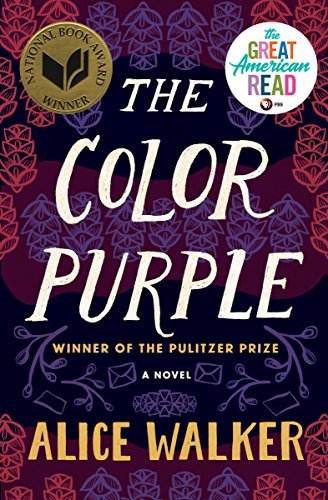
- Pulitzer Prize for Fiction (1983)
- National Book Award for Fiction (Hardcover) (1983)
- National Book Critics Circle Award Nominee for Fiction (1982)
- Townsend Prize for Fiction (1984)
A feminist work about an abused and uneducated African American woman’s struggle for empowerment, The Color Purple was praised for the depth of its female characters and for its eloquent use of Black English Vernacular.
Genre
- Classics
- Fiction
- Historical Fiction
- Feminism
- LGBT
- African American Literature
- Epistolary Novel
- Domestic Fiction
Trigger Warnings
- Racism & racial slurs
- Cultural appropriation, specifically Native American culture
- Domestic violence
- Physical, verbal & emotional abuse, including gaslighting
- Rape, statutory rape & rape of a child
- Incest (father-daughter)
- Pregnancy, result of rape & incest
- Forced estrangement
- Cheating
- Self-harm
- Disordered eating (bingeing)
- Emesis
- Alcohol consumption
- Female genital mutilation mentioned
- Lynching recounted
- Murder
- Gun violence mentioned
- Death of a mother
- Death of an infant
*There will be spoilers in this review. I will try to avoid major spoilers but some need to be brought up to be discussed.
**Like the book I will be talking about potentially triggering material. Please read with caution.
Summary
A powerful cultural touchstone of modern American literature, The Color Purple depicts the lives of African American women in early twentieth-century rural Georgia. Separated as girls, sisters Celie and Nettie sustain their loyalty to and hope in each other across time, distance and silence. Through a series of letters spanning twenty years, first from Celie to God, then the sisters to each other despite the unknown, the novel draws readers into its rich and memorable portrayals of Celie, Nettie, Shug Avery and Sofia and their experience. The Color Purple broke the silence around domestic and sexual abuse, narrating the lives of women through their pain and struggle, companionship and growth, resilience and bravery. Deeply compassionate and beautifully imagined, Alice Walker’s epic carries readers on a spirit-affirming journey towards redemption and love.
Characters
- Celie – Writer of most of the book a poor, uneducated Black woman with a sad personal history.
- Nettie – Celie’s sister. Writes her letters after they are separated about her travels.
- Pa/Alphonso – Celie and Nettie’s father. Rapes Celie and sells her to Mr. ____.
- Mr. _____/Albert – Celie’s husband. Abuses her regularly. Introduces Celie to Shug.
- Shug Avery – Blues Singer that Mr. _____ is in love with. Forms a bond with Celie.
- Harpo – Mr. _____’s son.
- Sofia – Harpo’s wife.
- Squeak (Mary Agnes) – Harpo’s mistress
- The mayor and his wife – Want Sofia as a maid.
- Eleanor Jane – Daughter of the mayor.Aattached to Sofia
- Samuel – a missionary who took in Nettie. .Adoptive father to Celie’s children.
- Corrine – a missionary who took in Nettie. Adoptive mother to Celie’s children.
- Adam – Celie’s son
- Olivia – Celie’s daughter
- Tashi – Olinka village girl that grows up with Adam and Olivia.
- Grady – Shug’s husband
Setting
Set in rural Georgia in the early 1900s, the story takes place through letters and writings describing the different homes that Celie lives in and all the travelling Nettie experiences from England to Africa.
Overview
It was one of those I couldn’t put down. Celie’s life was so hard, you just wanted something to go right for her. I wasn’t sure where it was going to go in the end and I was glad to see Celie come into her own strength and love. I grew up in Gorgia and the history felt very real.
It was hard to have opinions on the characters, the relationships being as messy as they were. I wanted to like Harpo. He was one of the few male characters to feel genuinely likeable. But then he tried to strongarm Sofia into obeying because it is what the men around him told him he should do. He felt weak in the end. Sofia on the other hand was a bada**. She was tough from start to finish. The characters growth through the years was a major strongpoint for me.
Pros
I got sucked into this story. The letter writing style always goes by quickly for me and by nature they tend to be short sections so it’s easy to just read one more. The vernacular took a second to get accustomed to but it helped me slip into Celie’s viewpoint better. The language sounded like a girl who had to learn the world through listening rather than being educated, and it really showed when compared to Nettie’s letters.
The characters were… I don’t want to say I liked them, they are, by design, not meant to be likeable. I will say they all had something redeemable about them, something human that made it harder to dismiss them. I have to say though, I am team Sofia and couldn’t really understand why Celie wouldn’t fight back even a little. Her life was hard and I can’t say I would have turned out different but it was difficult to take even vicariously. The cast was a strength of the work though and it would not have the layers it does without them.
Celie herself was one of the things I liked the most. You can’t help but root for her, she’s gone through so much crap and never tried to do anything but her best. Her successes towards the end of the work were up lifting but the best development was her own self-respect.
I thought I wouldn’t like Shug, I didn’t initially and I was miffed with Celie for pampering her as much as she did. But Shug was the first to see Celie, like really see her, since Nettie. Sure she was selfish and wild and she always did exactly what she wanted to do. No wonder Celie loved her, she was everything she thought she could never be. She might not be a hero I look to but I wasn’t trapped like Celie was in every aspect of her life. Shug was proof that she could be free.
Nettie and the missionaries were an intriguing insight to what was going on in Africa. The differences and similarities in family structure and culture was new to look at. I liked Nettie and the kids in particular.
Cons
The start was rough. Like really rough. I don’t necessarily want the details of child rape described but I guess it is an effective way to show the impact it had on Celie and how haunting it can be even just to read.
The characters on a surface level were so difficult to like. Sometimes they went to the extreme of not feeling believable. It’s hard to accept a person can be that malicious for that long. It should make you feel ill.
The real negative thing about this is the funk the majority of the book put me in. There are so many bad things that just keep happening its hard to find a reason to keep reading through it when it makes you feel so heavy. I’m glad I pushed through, again Celie’s development and growth are some of the most satisfying pages but it was rough getting there.
Final Thoughts
So overall, I get the hype. I feel a bit funky about it being a school read with the opening scene being as brutal as it was but I do get it. Understanding and being able to empathize with someone in Celie’s position, seeing the vulnerability and the lack of agency is uncomfortable. Uncomfortable but important. No one deserves to be treated the way she was and seeing the roots of hurt might make it easier to try and understand.
The complex characters, as unlikable as some of them are, add layers to the story that illuminate a different perspective. Like Shug as a hero to someone who felt like they never had the right or the strength to be selfish. How Shug can see the strength of Celie in a completely different way. Sofia was one of my favorite characters because she felt familiar. She fought for herself, she walked in with self-respect.
Would I recommend it? To certain people, absolutely. It is one of those important types of work that encapsulates a lot of feelings but they are harsh and can rub the wrong way. I do think everyone should give it a shot at least once in their lives.