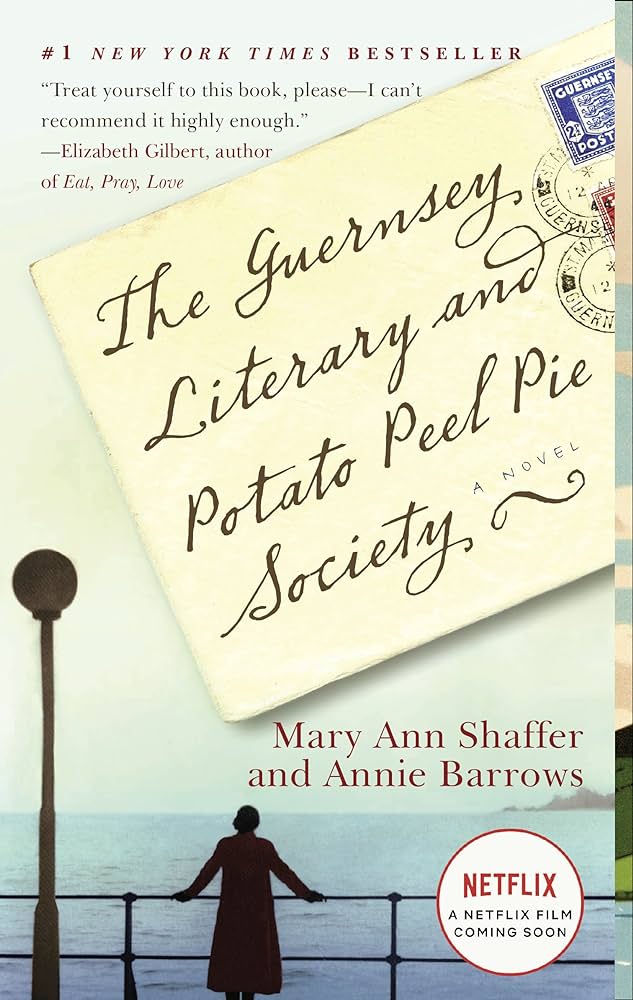
The Guernsey Literary and Potato Peel Pie Society

The Details
- Author: Mary Ann Schaefer and Annie Barrows
- Series: N/A
- Published: July 29th, 2008
- Page Count: 277 (Hardcover)
Personal
- Reading Start Date: November 9th
- Reading End Date: November 9th
- Format: Audiobook
- Rating: 8/10
Quotes
I don’t want to be married just to be married. I can’t think of anything lonelier than spending the rest of my life with someone I can’t talk to, or worse, someone I can’t be silent with.
I love seeing the bookshops and meeting the booksellers– booksellers really are a special breed. No one in their right mind would take up clerking in a bookstore for the salary, and no one in his right mind would want to own one– the margin of profit is too small. So, it has to be a love of readers and reading that makes them do it– along with first dibs on the new books.
That’s what I love about reading: one tiny thing will interest you in a book, and that tiny thing will lead you to another book, and another bit there will lead you onto a third book. It’s geometrically progressive – all with no end in sight, and for no other reason than sheer enjoyment.
Awards, Trivia, &
Indies Choice Book Award for Best Indie Buzz Book (Fiction) (2009)
Nominations:
LovelyBooks Leserpreis Nominee for Allgemeine Literatur (2009)
Genre
- Epistolary
- Romance
- WW II
- Historical Fiction
- Book Club
Trigger Warnings
- Animal death.
- Antisemistism.
- Death of parent.
- Hospitalization.
- Police brutality (Nazi occupation)
- PTSD (holocaust survivor)
- Slut shaming.
- World War 2 setting.
*There may be spoilers in this review. I will try to avoid major spoilers but some need to be brought up to be discussed.
Summary
January 1946: London is emerging from the shadow of the Second World War, and writer Juliet Ashton is looking for her next book subject. Who could imagine that she would find it in a letter from a man she’s never met, a native of the island of Guernsey, who has come across her name written inside a book by Charles Lamb…
As Juliet and her new correspondent exchange letters, Juliet is drawn into the world of this man and his friends—and what a wonderfully eccentric world it is. The Guernsey Literary and Potato Peel Pie Society—born as a spur-of-the-moment alibi when its members were discovered breaking curfew by the Germans occupying their island—boasts a charming, funny, deeply human cast of characters, from pig farmers to phrenologists, literature lovers all.
Juliet begins a remarkable correspondence with the society’s members, learning about their island, their taste in books, and the impact the recent German occupation has had on their lives. Captivated by their stories, she sets sail for Guernsey, and what she finds will change her forever.
Characters
- Juliet Ashton – author and protagonist
- Dawsey Adams – Juliet’s first Guernsey correspondent and close friend
- Sidney Stark – Juliet’s London-based publisher and friend
- Sophie Strachan – Sidney’s sister and Juliet’s best friend
- Amelia Maugery – Guernsey resident and hostess of the dinner party that started the Society
- Isola Pribby – Guernsey resident, quirky Society member, and vegetable and herb vendor
- Eben Ramsey – Guernsey resident and former postman
- Eli – Guernsey resident and Eben’s grandson
- Will Thisbee – Guernsey resident and creator of the first potato peel pie
- John Booker – A former valet for a wealthy British man on Guernsey
- Kit McKenna – Elizabeth’s adorable, ferret-loving daughter
- Elizabeth McKenna – London-born young lady who was caught on Guernsey at the war’s outset, and the quick-witted founder of the Society
- Christian Hellman – The German soldier that Elizabeth McKenna loved and the father of Kit McKenna.
- Remy Giraud – a Frenchwoman and friend of Elizabeth’s in a German concentration camp
Setting
The UK 1946, The Isle of Guernsey
Overview
I read this in one day. It was just so much fun. I don’t know if I could call it perfect, there were some far-fetched situations but it was funny and charming and engaging which is all I think it was trying to be. I do feel the hype works against it, not that it was unwarranted because I really can see why it was so accessible and enjoyable but it does set up this expectation that it has to be something that it isn’t necessarily trying to be.
The hype is what slowed me down as far as getting to reading it. I wasn’t sure what it was going to be when I saw it hovering on my TBR but I have to say it wasn’t what I thought it was going to be. The letters keep the pace moving and they are written with so much personality and charm. It was also one of those books that show a broad love for other books as well so it had me grinning a lot.
Pros
The writing was light and cheerful with a ton of personality saturating the letters that told the story. There was so much charm to the characters. Like I said before the style really kept the pace moving and I found myself swept away by the letters. I loved getting to know the islanders and hearing more about their histories.
The characters were a lot of fun too. Sometimes they felt a touch cut and dry, the good ones were quirky and accepting the harsher characters were nothing but bad. It works for the story and especially in personal letters but there were some occasions that felt a little over simplified. That being said I loved getting to know everyone and their eccentricities. The letters were used well to work with the “negative space” of a character, revealing things but not saying things directly or dancing around them in the most intriguing way.
I wasn’t sure at first how I felt about this kind of representation of World War II. It talks about bombings and occupations and death camps. It brings up the trauma and the fear people experienced in the unknowable times. It also shows the Germans in Guernsey as human, capable of kindness and empathy. It shows a population that had to ship out their children to protect them but also one that cared about some of the soldiers that were there to threaten them.
It felt unrealistic at first. Things were “too easy” the ravages of war glossed over for another witty line and I have seen some levelling criticisms at the book for the very same reason. But there are different ways the ripples of war touch everywhere. Having to send your kid away during uncertain times is terrifying on so many different levels.
Cons
So, yeah, the premise is a bit far fetched. The likelihood of a well to do author responding to a letter from a nobody far away, let alone sending books to a distant island when funds and life were hard seems pretty slim. That being said, there is the war to consider and people were wanting to connect and talk about what they had gone through. I don’t know, I could see it happening just maybe. I don’t know if I would really consider far-fetched a real criticism but it can distracting for some readers.
Juliet does have the tinge of Mary Sue going on but to be honest it wasn’t super noticeable to me. It might the overarching letter device, but it is a one on one interaction. People tend to be nicer and more flattering when there isn’t anyone else watching. Plus, I liked Juliet a lot as well. She had some crazy antics but it felt more like it was more of a case of her loud personality leaking through.
A big thing that might frustrate people is the soft way World War II is shown. The German soldiers are shown in a sympathetic light in some areas, one of them even painted as a *gasp* decent person. I felt honestly that it was probably a level of accurate as far as humans far from the actual fighting doing their “jobs.” Not all of them were decent. There was still a war going on and Elizabeth and Remy in particular suffered the consequences. Much of it was based on actual occupations events even if the characters were fabricated.
Final Thoughts
The hype kept me away from this for a long time. The title was also a strange emotional tie for me. My family has ties to the isle and I wasn’t sure how I was going to feel after being exposed to more information about it. Turns out I freaking loved it.
It was more simple than I thought it was going to be. Not in a bad way but I am not super into the crazy dramatic and I was not sure how this was going to play out. The epistolary style actually really worked for me. I know a lot of people took issue with it but I felt it gave a good sample of the characters and their personalities as well as keeping the story moving.