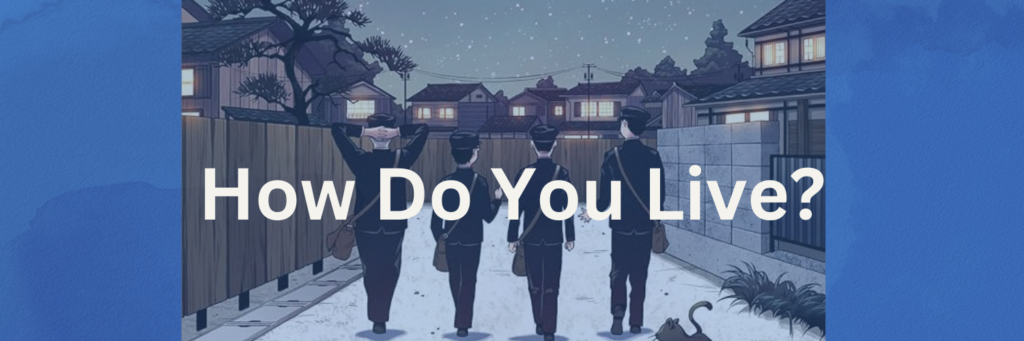
How Do You Live?

The Details
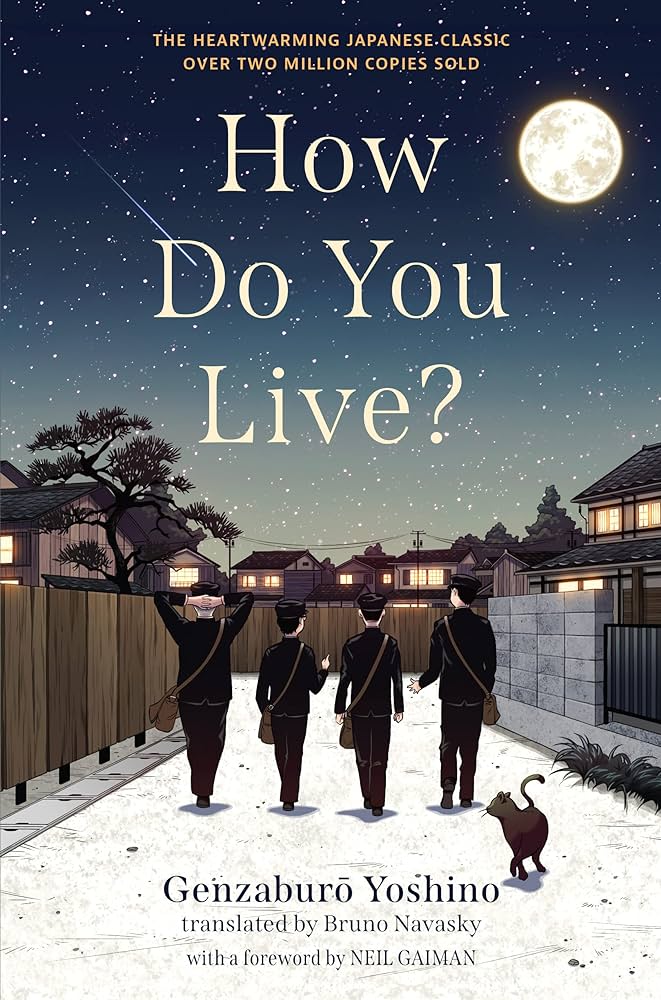
- Author: Genzaburo Yoshino
- Series: N/A
- Published: January 1st, 1937
- Page Count: 288 (Hardcover)
Personal
- Reading Start Date: January 19th, 2024
- Reading End Date: January 24th, 2024
- Format: Hardcover
- Rating: 8.5/10
Quotes
That is why I think the first, most basic step in these matters is to start with the moments of real feeling in your life, when your heart is truly moved, and to think about the meaning of those. The things that you feel most deeply, from the very bottom of your heart, will never deceive you in the slightest. And so at all times, in all things, whatever feelings you may have, consider these carefully.
You take many things from the world, but I wonder what you will give back in return?
We have the power to decide on our own who we will be. Therefore, we will make mistakes.
However-
We have the power to decide on our own who we will be. There, we can also recover from mistakes.
Awards, Trivia, &
Hayao Miyazaki’s favorite childhood book that inspired The Boy and the Heron
Nominations:
Translated into English in 2021
Genre
- Fiction
- Classics
- Japanese Literature
- Middle Grade
- Philosophy
- Essays
- Coming of Age
Trigger Warnings
- Bullying
- Fatphobia
- Mentions of war
- Classism
*There may be spoilers in this review. I will try to avoid major spoilers but some need to be brought up to be discussed.
Summary
How Do You Live? is narrated in two voices. The first belongs to Copper, fifteen, who after the death of his father must confront inevitable and enormous change, including his own betrayal of his best friend. In between episodes of Copper’s emerging story, his uncle writes to him in a journal, sharing knowledge and offering advice on life’s big questions as Copper begins to encounter them. Over the course of the story, Copper, like his namesake Copernicus, looks to the stars, and uses his discoveries about the heavens, earth, and human nature to answer the question of how he will live.
Characters
- Jun’ichi/ Copper – fifteen year old who is trying to learn how to navigate the world
- Mother – Copper’s mother and one of his guiding forces after his father died
- Uncle – his mother’s brother who takes to writing him letters to help him understand the world
- Mizutani – Copper’s quiet thoughtful friend
- Kitami/ Gatchin – Copper’s bold friend who believes in taking action
- Uragawa – A hardworking and quiet classmate who is bullied in class
Setting
Tokyo, Japan early 20th century
Overview
I didn’t know what to expect. The most I had heard about it and the biggest reason I wanted to get my hands on it was because it was one of Hayao Miyazaki’s favorite books growing up and he just recently released his latest film based on the work.
I have to say for a book of essays and life lessons this was beautiful.
It is relatable and poignant, the story adding to the truths Copper has to learn. I also genuinely appreciate the approach this novel takes, showing the beauty of the world and all its ways through love and strength.
Pros
I love the way this book shows friendship. The pain Copper goes through after he made the choices he makes was something I think almost every adolescent experiences. He has different types of friends and he learns how to be himself with them. I love how the book encourages knowing yourself and valuing what it is that truly makes us human. It allows for us to recover from our mistakes and to forgive ourselves for not meeting our own expectations.It shows many of the boys having different backgrounds and different view points as they go through life and school and how they can complement each other despite their differences.
I appreciated how real Copper and his friends felt and how the lessons were grounded in growth rather than in punishment.
The book focuses on many types of lessons, from ethics to astronomy to history in engaging and relatable ways. If I had read this when I was younger I feel like it would have helped me remember some of these concepts through school.
Cons
The letters can pull you out of the story. The split perspectives might change how the prose hits for some readers especially when the uncle’s letters have that essay nonfiction feel. As an adult with children in my life that I care about, I was able to relate to both him and Copper so this is more of a style comment than a con.
Final Thoughts
I think it’s one of those books everyone would benefit from reading. It has such good overarching lessons that I feel it could build stronger thought processes. One of the things I struggled with through adolescence was losing friends through disagreements and seeing things work out for Copper was almost therapeutic.
All in all, I can’t recommend it enough.